
I wrote this a couple-few years ago, when I still lived in West Virginia. It didn’t find its way into my next book so I thought I’d share it here. Some of it is out of date by now—aluminum tariffs were imposed just after I talked to Palmer, and that probably would’ve shifted the focus of our conversation a bit—but the recipe is still good!
Deep in western Maryland, just a few miles from the West Virginia state line and quite a ways off Interstate 68, you’ll find a nondescript building in a small industrial park outside the town of Oakland, population 1,873. Inside the building are nine die-casting machines so large that if you ordered one from China—because they’re no longer made in the United States—it’d be taken apart and sent to you in two shipping containers. This is where the good pizzelles begin.
..

Even today, when a preteen in Tempe can hop on the internet and find six articles about the “Pittsburgh cookie table” (that’s what preteens do on the internet, right, read about regional wedding celebration traditions?), pizzelles, thin waffle-like cookies of Italian origin, usually anise flavored, are still relatively rare outside Pennsylvania, northern West Virginia, Cleveland (apparently), and among the retired in Florida. Few people bring them to cookie swaps, they don’t appear in Good Housekeeping cookbooks, you won’t find them in your average Albertsons. There are good reasons for this lack of ubiquity: not only do they require a specialized kitchen appliance that few people are willing to devote precious cupboard space to, but pizzelles are extremely fragile—the best ones especially so—and it’s devilishly hard to find tins or other containers in which they’ll fit for storage, much less transport. You make pizzelles, stacking them up as they cool, and then you eat them.
The other reason, I believe, is that even if you’ve invested in a pizzelle iron, you may have been so frustrated by a poor-quality iron and the myriad ways in which a pizzelle batter itself can go wrong that you’ve abandoned the cookie altogether. If it makes you feel any better, you wouldn’t have been the only one to throw your cheap-ass lightweight Chinese-made Teflon-coated pizzelle iron in the trash in a fit of rage. Eggy, sugary pizzelle batter has a tendency to stick and to burn quickly. Nonstick coatings do very little to prevent these outcomes—they just make cleanup harder. And there are so many old family recipes for pizzelles out there that it’s all too easy to hit upon one that’s going to cause problems. It’s a challenging cookie, but I’m here as a survivor to tell you that you can make them and they will be delicious. All you need is the right iron and the One True Pizzelle Recipe.
My mom was introduced to pizzelles by a college roommate, who was from Monroeville, near Pittsburgh, and I was lucky enough to have had a mom who was able to master the form so I could grow up with pizzelles myself. I’ve been mildly obsessed with them since I left home as a young adult and realized that none of my new friends in New York, arguably the most cosmopolitan city in the country, had any idea what I was talking about when I described them. At one point, Manhattan-apartment cupboard space be damned, I bought the only pizzelle iron I could find (this was just before the internet exploded and made the concept of “obscurity” nearly obsolete); I think it was a VillaWare or maybe a Chef’s Choice. I cried every time I tried to use it. The ridges and valleys that were supposed to form the intricate design in the surface of each cookie were too shallow to make much of an impression, the flimsy plates heated unevenly, and the nonstick coating . . . wasn’t. I threw it away and tried to put pizzelles out of my mind, which I was able to do for the next eight or so years thanks to New York City’s many distractions, culinary and otherwise.
And then we moved to within an hour and change of Pittsburgh.
Walk through the city’s madcap Strip District, weaving among sidewalk sale tables piled with Pirates, Steelers, and Pens swag, shoppers with Wholey’s fish market bags dripping melted seafood ice, people stopped mid-block to eat spicy mung bean sprout pancakes or messy gyros escaping their foil wrappers, cigar-smoking espresso drinkers, and tourists and locals lined up outside the diner known for its weirdly thin pancakes. Step in and out of densely stocked Italian and Greek food markets, and into the tent-protected spaces between the brick buildings, and you’ll notice that those doily-like cookies are everywhere—you can buy some, but they won’t be nearly as good as homemade: they’re too sturdy! Instead, look up on the top shelves in some of those food markets, and you’ll see electric pizzelle irons for sale. They’ll seem old-fashioned, vintage, almost used, in their dusty boxes. Find one with the goofy Made in the USA logo: that’s a Palmer iron, and it’s the one you want—in particular, the Palmer 1000, which has plain aluminum plates, not-nonstick. (You can also just skip the Strip and call Darcy, in the Palmer facility outside Pittsburgh, to order one by mail.)
This brings us back to rural Maryland, to the small town on the Youghiogheny River where the only US-made pizzelle irons are cast in aluminum by C. Palmer Die Casting. The parts are put on a truck and taken about two hours northwest, to Darcy’s small team in West Newton, Pennsylvania, also on the Yough (pronounced “yock”), to be assembled and fitted with their simple electrical components.
..


I called up Phillip Palmieri, who runs the foundry in Maryland, and kind of falteringly asked if I could come see how the pizzelle irons are made. He didn’t ask who I was or why I wanted to know (and I couldn’t have given a good answer if he had); he just said sure, his workday starts at 6 a.m., I’d be welcome to come by after then, and he gave me directions to the industrial park, which was a pretty and surprisingly quick drive over the mountains from my home in Morgantown. We talked for an hour and a half the next morning in his brightly lit office, which was spotless and smelled only faintly of hot liquid metals. There was a bank of video feeds on the wall behind me showing the factory floor from every angle. He didn’t seem to check them very often as he talked. I’d already read several accounts of the founding of the family business, but I asked him to tell me about it anyway.
Phillip’s grandfather, Carmen (né Carmine) Palmieri, was born in the Abruzzo region of Italy (the lower calf of the boot) in 1914 and arrived in the Pittsburgh area as a teenager to lie about his age and work in the coal mines. Carmen took a job in a steel mill and lasted two days before heading back to the mines, where the conditions underground were more palatable: no blast furnaces. He worked as a machinist at U.S. Radiator in West Newton, a small city so dominated by coal works and the accompanying big industry by the 1890s that the largest concern in town, a paper mill, had to pack up and move to New England because the water had become too sulfuric to use in its operations.
It was in West Newton that Carmen struck out on his own and started sand casting aluminum to make traditional-style stovetop pizzelle irons in his basement, using a design he’d conjured from his childhood in Abruzzo. This was in 1946, and even though he was selling a distinctly Italianate product—and you’d think people would want to buy pizzelle irons made by a Palmieri—Carmen soon changed the name of his company to C. Palmer and was able to expand his business beyond pizzelle irons to basically anything cast from aluminum and later also zinc, first using sand casts and then dies. His son John Palmieri, who’d trained as an electrician in the navy, took on the business and developed the electric irons that pizzelle enthusiasts like me use today.
John’s son Phillip told me he moved the die-casting part of the business to Maryland about eighteen years ago in response to labor pressures in (cleaned-up, post–regulatory regime) West Newton. Here the story takes a turn from Hardworking Immigrant Bootstrapism to Lament of the Small Business Owner, and I found myself becoming more radicalized by the minute.
C. Palmer makes about three thousand pizzelle irons a year, and Phillip said he doesn’t really care whether he sells more or fewer of them. “It’s a niche product,” he said, and he isn’t exactly counting on a sudden surge of interest in pizzelles. The company’s waffle irons were featured on a late-night cable talk show a couple years ago, and Phillip said sales remained pretty much flat. “It was a humorous bit, though.”
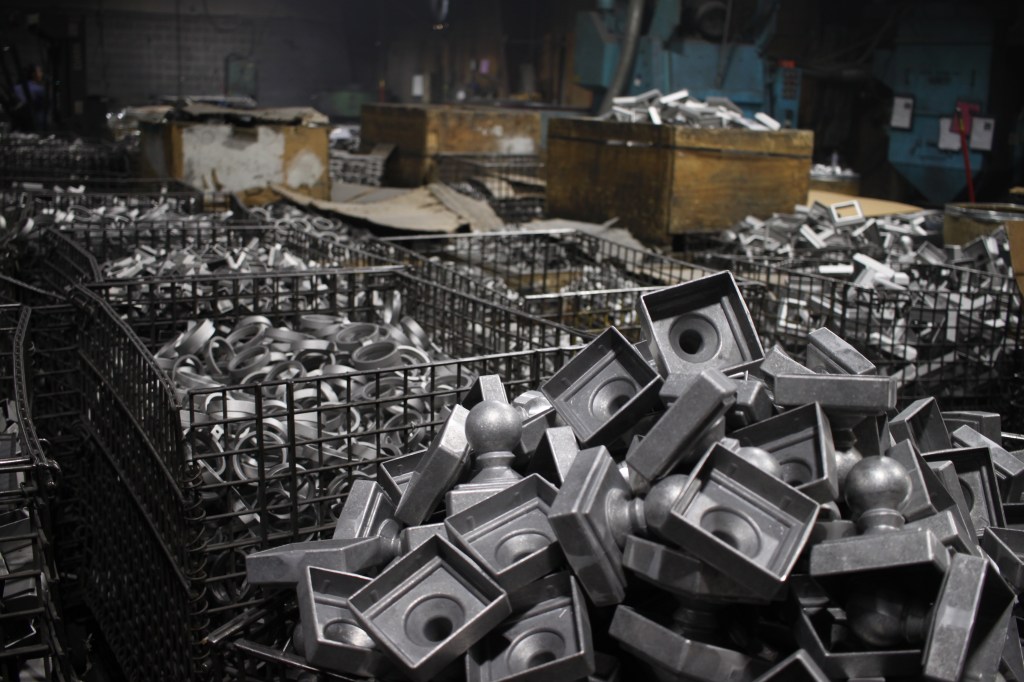
His machines can spit out the parts for about 750 pizzelle irons a day, which means an entire year’s production can happen in less than a week. Pump parts, wheel casters, plates for electrical grid systems, cemetery urns: that’s where the money is. Aluminum fence pieces, like the fleur de lis finials that fit over the tops of metal fence poles, account for 60 to 70 percent of his business. People are always going to need more electrical plates and fleur de lis, while the folks calling him about pizzelle irons are “little old ladies” who want to know why their cookies are always burning. “I ask them, ‘Do you answer the phone while you’re making them? That’s why they’re burning.’”
The problem facing any business producing things like individual fence parts—and there are a lot fewer die-casting companies in the United States now than there used to be—is Mexico. And China. In an industry in which pennies make all the difference and international shipping costs have become negligible, competition from companies that have moved their manufacturing abroad can be devastating. Palmer Die Casting can’t charge its customers much more than it already does (I imagine there’s only so much quality people need in a finial), can’t pay its employees less than it already does (most are at minimum wage already, I gathered, and Phillip said that workers are increasingly hard to come by; he told me about a kid who failed to identify a crowbar on sight when Phillip asked him to hand him one), and can’t increase production much more without making a huge investment in equipment—not to mention employee benefits.
About forty-five people work for Palmer, most of them manning the tricky-looking high-pressure die-casting machines and stirring chest-high vats of molten aluminum and zinc. Phillip said he’d never have fifty on the payroll, because, of course, the company would have to provide health insurance, an administrative hassle he’s not prepared to deal with. Until health insurance is untethered from employment, then, Palmer Die Casting will likely remain small. I’d also venture that an international workers’ union to reverse the race to the bottom wouldn’t hurt the manufacturing industry in this country either. I was a little unnerved, to be honest, when Phillip led me into the die-casting area itself, dim and loud, and hot despite the windows in the ceiling, which he said were permanently open year round to allow as much ventilation as possible. The beautifully fine, intricate designs in the die for the pizzelle irons, and in the fencepost finials and the thousands of other aluminum parts in huge bins awaiting shipment across the country, seemed quite out of place in this room full of heavy industrial machinery, open flames, and steam. I thought about how Phillip had scoffed at employees who’d rather work in a big-box store where they can duck into the next aisle when the boss walks by. Standing next to aluminum at over 1,000 degrees Fahrenheit, I figured I’d probably choose an air-conditioned retail environment too, especially if the pay were comparable.
I’m suspicious of bosses in general, but still I had some sympathy for this one, who was making excellent—and in my opinion the only viable—electric pizzelle irons for what seemed to be purely sentimental reasons. Phillip told me about a die-casting guy back in the day who liked to fly antique military aircraft, until he was killed doing a nosedive into the ground. His point was that flying was an expensive hobby, and that die casting guys nowadays could only dream of doing things like flying antique military aircraft for fun. He described how he felt when he moved the die-casting machines from greater Pittsburgh to rural Maryland: “I felt like the guy in . . . what’s that movie?” (I knew which movie he meant.) “I felt like Doc Hollywood!” He seemed happy enough, if resigned to the structural limitations of a third-generation die-casting business in the twenty-first century.
Could pizzelles be the next fondue, or espresso, or, I don’t know, cake pops—which hit the big-time even though they require special equipment to produce? Probably not. Or if they did become suddenly popular, perhaps the long-handled hinged stovetop pizzelle irons (hold it over a gas burner, say a Hail Mary, flip it and say another, and the cookie’s done) would hold more appeal to a new generation of DIYers than the less messy, much more convenient electric ones that Palmer makes. There was a former steelworker from maybe Wheeling, Phillip said, somewhere in the West Virginia part of the Pittsburgh orbit anyway, who would come in to the West Newton location every once in a while with shopping bags full of his latest innovations in pizzelle flavors for the Palmer employees to try. Flavors like watermelon. There was a Pittsburgh woman who used seven Palmer irons at once, assembly line style (picture her smoking, sparking breaker box!), and would visit West Newton to replace the ones she’d grown tired of cleaning—filling that many active irons, she’d certainly have more drips and overflow events than I do filling only one. But those folks are few and far between.
Phillip Palmieri has probably heard things like this before, stories meant to be encouraging, but I will say that when my neighbor learned that I was making pizzelles at Christmastime, he promptly ordered up a Palmer 1000 and asked for my mom’s recipe.
When my mom sent me her recipe, she said, “Don’t even bother with other recipes.” Heed this advice. Futz around all you’d like with the flavorings—lemon zest and extract, or just plain vanilla are other traditional pizzelle flavors—but keep the rest of the ingredient proportions the same. You can also experiment with folding or molding the warm pizzelles into cups or cannoli-like tubes for filling—and I’ve seen some spread with Nutella or jam before being rolled up, jellyroll style. When my daughter’s manning the pizzelle iron, she likes to let the pizzelles cool and firm up in the weirdest configurations possible, which makes finding storage containers for them even more challenging than usual.
Before you use a not-nonstick pizzelle iron for the first time, I’d strongly suggest seasoning the plates to make sticking less likely. Plug in the iron and let it heat for a good ten minutes, then brush or rub the plates’ surfaces with vegetable shortening (the nonhydrogenated kind is what I use, and it works well), getting it in all the nooks and crannies. Unplug and let the iron cool completely. When you’re ready to cook, plug it in and let it heat up for ten minutes, and brush with shortening again before you add the batter; after a few sets of cookies, you won’t have to grease every time, just when you start to notice a little resistance as you peel the cookies off the plates.
..

Pizzelles
Makes about 48
..
6 eggs
1 1/2 cups sugar
1 cup vegetable oil
1 tablespoon anise extract
1 tablespoon anise seeds, lightly crushed
1 teaspoon lemon extract
2 cups flour
2 teaspoons baking powder
1/8 teaspoon kosher salt
Vegetable shortening for cooking
..
Whisk everything except the shortening together in a large bowl. Cover and chill in the refrigerator for 2 hours, or up to several days. Preheat a pizzelle iron, brush with a little shortening, and add a spoonful of batter for each pizzelle (you’ll get the hang of how much you’ll need), close the iron, and cook until golden (lift the top after about 20 seconds to take a peek). Use a fork to transfer the cookies to a plate or the counter to cool and stiffen. After they’ve cooled and become crisp, you can stack them. Store in an airtight container—they’ll keep for at least a week—or you can freeze them.
A note: The instructions that come with the Palmer iron tell you to clamp the handles together when you close the plates with batter inside, but don’t do this: squeezing the plates together tightly makes a too-thin cookie and causes a lot of alarming sputtering and spitting from the seam between the plates. Just lower the lid and let it be.
Tagged: cookies, Pittsburgh, pizzelles, recipe, West Virginia
 Liana Krissoff